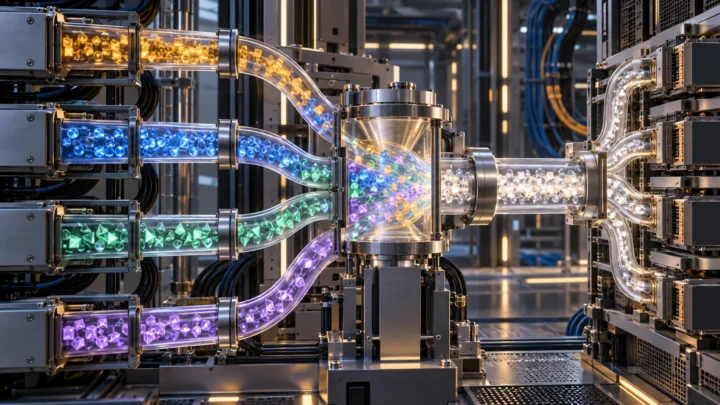

NVIDIA has documented a digital-twin and agent workflow for testing supported AI-factory configuration and software changes before hardware arrives or changes are promoted to production. For platform teams, the design offers a sandbox for exercising an assembled infrastructure stack and producing evidence for a governed promotion decision rather than using production as the first test environment.
The guide centers on NVIDIA DSX Air, which the company describes as a node-based, executable representation of AI-factory infrastructure and operational interfaces. Teams can model topology and supported software, exercise a change through APIs, observe the resulting behavior, and integrate validation into CI/CD. NVIDIA’s Figure 1 depicts the DSX Air node-based simulation, while Figure 2 frames effective simulation around scale, simulated infrastructure and ecosystem integration.
Test the assembled system, not one layer alone
NVIDIA argues that an AI factory’s behavior emerges from interactions among accelerators, network fabric, storage, Kubernetes and scheduling, GPU orchestration, tenant isolation, identity and access controls, observability, and applications. Its proposed logical twin is intended to let teams validate supported configurations and integrations before a full physical system is racked, cabled and brought up, including representative large-scale designs and network fabrics.
The company does not position node-based simulation as a universal substitute for other models. It assigns it to integration and operational validation of supported configurations and software, while cluster, performance, power and memory models inform capacity and resource planning within their respective validated scopes. A performance model may estimate a configuration’s effect; NVIDIA says the twin instead shows what happens when the intended APIs, policies, orchestrators and software run together. Workload and performance estimates still need suitable models or measurements, and vision inspection needs relevant image or video inputs.
Agents propose outcomes under controls
In NVIDIA’s example loop, an infrastructure or software change enters a CI/CD or change-management process. An agent selects or configures a relevant twin using the topology, tenant policy, workload profile and operational constraints, then uses approved tools for available configuration, security, compliance and infrastructure-health checks. It compares results with approved documentation and policy, then produces an evidence-backed report that can recommend promotion, open remediation work or route the case for human approval.
NVIDIA explicitly characterizes this as governed automation, not unrestricted production authority. The twin is where agents can explore and test; policy, identity and human-in-the-loop controls determine whether a result affects production. After deployment, the same pattern can use production signals to refine the twin, validation suite and operating procedures. The guide applies the common model through Day 0 planning, Day 1 deployment and Day 2 operations.
DSX Air supplies the twin; Brev supplies GPU-backed services
NVIDIA positions DSX Air as the simulation environment and NVIDIA Brev as a source of on-demand GPU resources for a developer or workflow. In the described setup, a DSX Air user connects to Brev, chooses a GPU-backed launchable and makes it available to the logical-twin workflow. Figure 3 shows the selection of an on-demand GPU instance in Brev; Figure 4 shows a Brev GPU resource represented in the DSX Air twin; and Figure 5 depicts Brev-powered agents interacting with the twin across the lifecycle.
The intended outcome is a repeatable workflow in which compute-backed AI services connect to a representative factory environment, rather than a standalone demonstration. NVIDIA says the shared organizational context in NGC can streamline the connection across the simulation environment and GPU service.
Video intelligence is the worked example
NVIDIA uses its Video Search and Summarization blueprint to demonstrate the architecture. The VSS environment is simulated in DSX Air, but its AI models run outside the simulation on Brev GPU instances. An agentic layer collects request parameters, invokes video analysis, retrieves policy or domain context, generates a cited report and can route a result to downstream systems such as Jira.
Figure 6 presents four layers: orchestration through NemoClaw and human-in-the-loop prompts; a VSS agent for video functions, retrieval and reporting; the RAG Blueprint with a RAG API, Milvus and Nemotron reranking NIM; and an LLM-fusion layer that enriches the video summary with retrieved context. NVIDIA says this pattern could inspect a simulated or real workflow, correlate an exception with twin state, retrieve operating material, and generate a traceable remediation task or request for human review.
These are vendor-described implementation patterns, not independently measured deployment results. NVIDIA recommends starting with one bounded recurring loop and tracking validation coverage, decision time, false positives, remediation outcomes, and differences between simulated and observed behavior. The stated scope remains supported configurations and software integrations, with production action subject to organizational controls. Source: NVIDIA Developer Blog
Definition. A logical AI-factory twin is an executable representation of supported infrastructure and operational interfaces used to test integrations and changes before promotion.
| Component | Role in the described workflow |
|---|---|
| NVIDIA DSX Air | Node-based simulation environment for the logical AI-factory twin. |
| NVIDIA Brev | Source of on-demand GPU resources for workflow services. |
| Bounded agents | Run approved checks, compare findings with policy and produce evidence-backed reports. |
| Human and policy controls | Determine whether validation results may affect production. |
Key takeaways
- DSX Air is positioned as a node-based simulation for integration and operational validation of supported configurations and software.
- The workflow tests interactions across infrastructure, policies, orchestration and applications rather than a single layer in isolation.
- Agents use approved tools and evidence-backed reporting to recommend promotion, remediation or human review.
- NVIDIA Brev provides on-demand GPU resources for services connected to the logical-twin workflow.
- The approach is a vendor-described implementation pattern, not independently measured deployment evidence.
- NVIDIA recommends beginning with one bounded recurring loop and tracking validation and remediation outcomes.
FAQ
What is NVIDIA DSX Air used for in this workflow?
NVIDIA describes DSX Air as a node-based, executable representation of AI-factory infrastructure and operational interfaces for validating supported configurations and software integrations.
Does the workflow give agents unrestricted production authority?
No. NVIDIA characterizes it as governed automation: agents explore and test in the twin, while policy, identity and human-in-the-loop controls govern production effects.
What role does NVIDIA Brev play?
Brev supplies on-demand GPU resources for developer or workflow services connected to the DSX Air logical-twin environment.
Can the digital twin replace all other models?
No. NVIDIA assigns the node-based twin to integration and operational validation, while performance, power, memory and other models remain relevant within their validated scopes.