NVIDIA’s Seattle Robotics Lab and Isaac engineering team have documented robotic systems for assembling GB300 tester trays, reporting more than 95% success for busbar assembly and 90% to 95% for a four-connector task. The results give manufacturers a practical account of how flexible automation can handle variable, contact-heavy hardware work, while also showing that neither system yet meets the factory targets set with NVIDIA Operations and Foxconn.
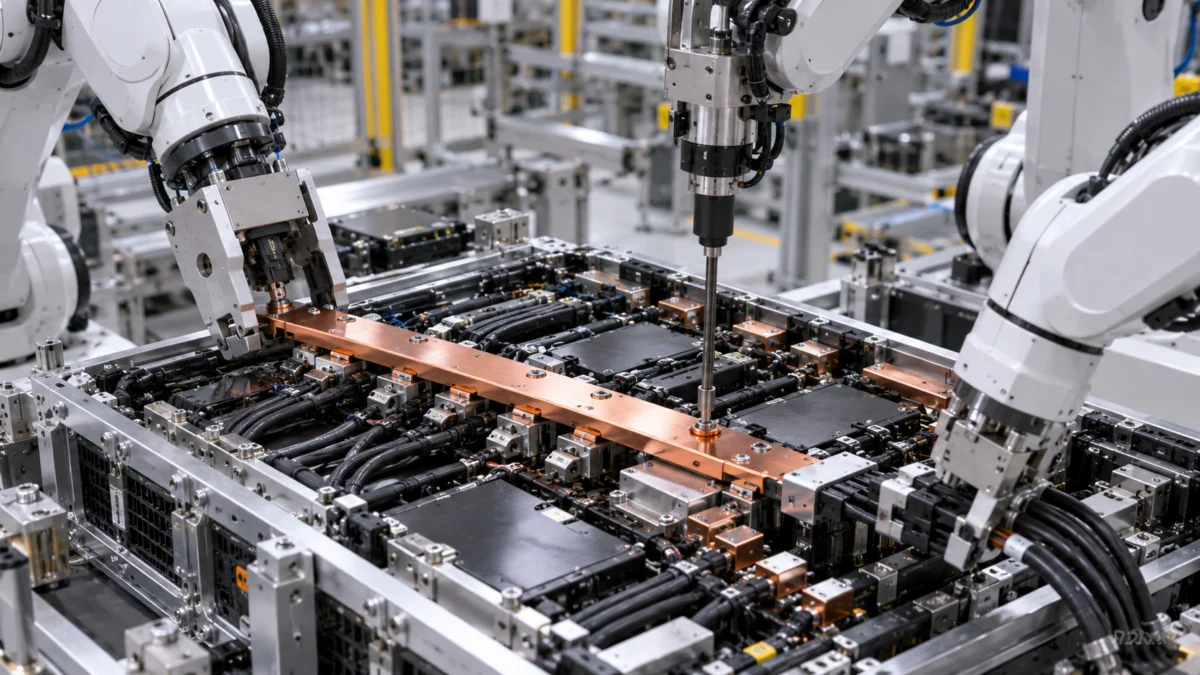
GB300 tester trays are used to verify compute modules before shipment and deployment. NVIDIA focused on two operations: placing and fastening a long, heavy busbar at 16 locations, and lifting, grasping and inserting two large and two small cable-mounted connectors into tight-clearance sockets. Unlike fixed automation, which constrains parts with dedicated fixtures, this work must accommodate changing part poses, uncertain geometry and deformable cables because rapid design cycles and lower volumes make tightly controlled setups impractical.
Industrial requirements set a higher bar
NVIDIA says the manufacturers requested at least 99.5% success for both tasks, no unintended collisions with the tray, and completion within twice the time of skilled workers. That translates to a 124-second limit for busbar assembly and 72 seconds to insert all four connectors. The company frames these thresholds as more demanding than many robotics demonstrations, where success rate alone is often the primary measure.
The source also emphasizes the evidence burden behind a 99.5% requirement. NVIDIA says that supporting a success probability of at least 99.5% with a one-sided 95% confidence bound would require observing zero failures in at least 598 trials. Wear on the specialized components means that level of testing could require hundreds of duplicate GB300 parts, adding a practical constraint beyond algorithm development.
A modular stack handled busbar assembly
For the busbar task, NVIDIA began with a modular pipeline rather than an end-to-end learned policy. A three-arm cell assigned one Flexiv Rizon 4S arm to position a camera, a second to insert and later remove the fixture, busbar and clamp, and a UR10e equipped with an OnRobot screwdriver to fasten the 16 screws. The team says this separation of perception, planning and control made the system easier to debug, tune and distribute across the robots.
The perception stack initially used FoundationPose, but limited visibility could produce pose errors of 90 or 180 degrees. NVIDIA mitigated that by producing estimates from multiple views and selecting the higher-confidence result. Its planning paired fast free-space waypoints with simple alignment motions, while an impedance controller using automatic damping design and inertial compensation was intended to keep contact stable and gentle during insertion.
That approach produced busbar-assembly success above 95%, according to NVIDIA. The remaining failures were mainly grasping errors and in-hand slippage. Its limit-fixture and busbar subtasks met their timing requirements, but the full cycle took 160 seconds, missing the 124-second target because the screwdriver’s sequential, device-specific operations were the bottleneck. The result is not a claim of factory readiness; it is evidence that a conventional, high-performance control stack can be effective for part of a problem often assumed to require end-to-end learning.
Connector work exposed the limits of data and simulation
Multi-connector insertion was harder because cable shape and stiffness vary, repeated manipulation can permanently deform the cables, the connectors are small and nearly textureless, and the sockets leave little room for error. NVIDIA first used SAM3 segmentation in a predefined overhead-image region, fitted a centerline to each cable mask, then grasped the midpoint and lifted it to expose the connector. The company says this cable-grasping stage produced almost no observed failures.
General-purpose pose estimation did not work reliably on the exposed connectors, and NVIDIA says its trials with behavior cloning, action-chunking transformers and diffusion policies also delivered low success rates. The stated problem was not simply model selection: the team had only a small number of specialized cables, their mechanical properties varied, and repeated use altered them. NVIDIA calls this an “inverse bitter lesson,” arguing that physical, financial and logistical constraints can make the data scale sought by end-to-end methods unattainable.
Its alternative was Deep Object Pose Estimation Revisited, or DOPER, a specialist perception framework. DOPER begins with a CAD model for a specific part, renders synthetic RGB images and generates keypoint labels. It then uses a 3D neural reconstruction of the actual part to generate and correct pseudolabels for real-world fine-tuning. At runtime, NVIDIA says it extracts pose estimates from predicted keypoints at camera rate, 30 Hz or faster. Those estimates let one arm reorient a connector into a pose another arm could grasp.
The team also used mechanical design to reduce uncertainty rather than asking software to recover from every disturbance. Its two sets of multipurpose gripper fingers were designed for the busbar, fixture, clamp mechanism, cables and both connector sizes. Their geometry constrains a connector during gripper closure so that it settles into a more repeatable post-grasp pose. NVIDIA says the fingers can be reproduced with a hobby-level 3D printer, illustrating its broader argument that robot reliability depends on the combined design of hardware, perception and control.
Real-world learning improved insertion, but deployment remains ahead
For final connector insertion, NVIDIA trained model-free reinforcement-learning policies in Isaac Lab and transferred them to the physical setup. Simulation-to-real transfer achieved high success rates for the large connector, the company says, but was less effective for the smaller one, where minute pose-estimation errors could lead to an edge slip. NVIDIA says the reliability of even the large-connector policy did not meet industrial standards.
The team then extended its SPARR approach: a state-based base policy is trained with reinforcement learning in simulation, while a residual policy is trained in the real world. Because the connector is occluded during insertion, the residual policy used force-torque inputs rather than images. This pairing uses simulation to initialize behavior while relying on real interaction data to correct remaining mismatch between the simulator and the factory-like task.
The integrated system that handles cable grasping, connector grasping and insertion achieved 90% to 95% success and averaged 40 seconds per cable, NVIDIA reports. Multi-arm coordination during connector grasping was the chief failure source, while slow discrete adjustment of exposed-connector poses was the chief timing bottleneck. At four cables, the reported average also exceeds the manufacturer’s 72-second limit for the complete task, and the success rate remains below 99.5%.
NVIDIA says its next objective is to deploy the technology in factories operated by its contract manufacturers, meaning that deployment has not yet occurred. It identifies distinct ambient and workcell conditions, product design changes and domain mismatch as outstanding risks when moving from laboratory trials to production. The company proposes a supervised deployment model in which interventions are recorded and used to improve the system over time, but that is presented as a path forward rather than a demonstrated production outcome.
The work also describes supporting infrastructure: containerized robotics services for components such as motion planning, pose estimation and depth estimation, plus TALOS, a control and orchestration system that can sequence controllers and learned policies in loops faster than 500 Hz. NVIDIA says it is preparing a whitepaper and working toward community releases of DOPER, TALOS and connector-insertion reference workflows. Those are prospective releases, not currently announced availability.
Source: NVIDIA Developer Blog
Definition. GB300 tester trays are used to verify compute modules before shipment and deployment.
| Task | Reported result versus target |
|---|---|
| Busbar assembly | Above 95% success; 160-second full cycle versus a 99.5% and 124-second target. |
| Four-connector handling and insertion | 90% to 95% success; 40 seconds per cable versus a 99.5% and 72-second complete-task target. |
Key takeaways
- Manufacturers requested at least 99.5% success, no unintended tray collisions and strict cycle-time limits for both tasks.
- The busbar system exceeded 95% success but took 160 seconds, above the 124-second target.
- The four-connector system achieved 90% to 95% success and averaged 40 seconds per cable, exceeding the 72-second four-cable limit.
- NVIDIA used modular perception, planning and control for busbar assembly, with screwdriver operations limiting cycle time.
- DOPER specialist perception and mechanically designed gripper fingers helped reduce uncertainty in connector handling.
- NVIDIA describes factory deployment as a future objective, with domain mismatch and production conditions still unresolved.
FAQ
What factory targets did NVIDIA’s GB300 robots need to meet?
The requested targets were at least 99.5% success for both tasks, no unintended collisions with the tray, and completion within twice the time of skilled workers: 124 seconds for busbar assembly and 72 seconds for four connectors.
How successful was the GB300 busbar assembly system?
NVIDIA reported busbar-assembly success above 95%, but the full cycle took 160 seconds and missed the 124-second target.
How successful was the connector insertion system?
The integrated cable grasping, connector grasping and insertion system achieved 90% to 95% success and averaged 40 seconds per cable.
Has NVIDIA deployed these GB300 assembly robots in factories?
No. NVIDIA identifies deployment with contract manufacturers as its next objective and presents supervised deployment as a path forward.
Why was connector insertion difficult?
Cable shape and stiffness varied, repeated handling could deform cables, connectors were small and nearly textureless, and the sockets allowed little room for error.