
Researchers Ivan Moshkov, Stephen Ge, George Armstrong, Wei Du, Sadegh Mahdavi and Igor Gitman developed two specialist Nemotron 3 Ultra checkpoints and an inference pipeline that they report scored 30 out of 42 points at IMO 2026, reaching the gold-medal threshold. For AI researchers, the work provides an open recipe for studying how post-training and additional inference-time computation affect difficult mathematical proof generation.
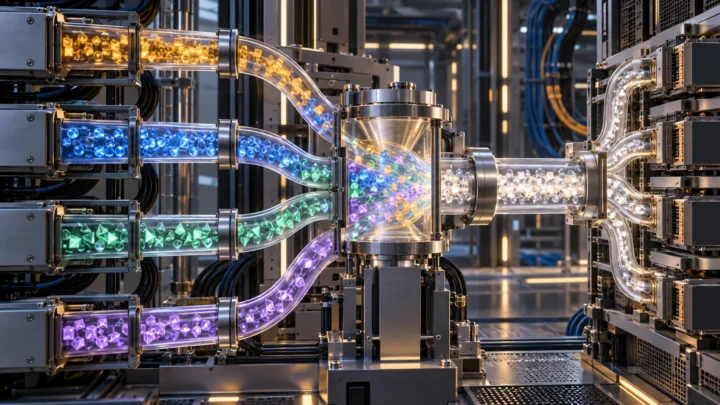
The specialists were trained with supervised fine-tuning and reinforcement learning. At inference time, the system combines those models with the generally available Nemotron 3 Ultra checkpoint in an iterative search: the models generate, verify and refine candidate proofs, after which a separate high-compute stage selects the final submission.
The pipeline works entirely in natural language. According to the paper, it uses no formal theorem prover, external tools or internet access, making the reported result evidence about model-based proof search rather than a hybrid system assisted by symbolic software or online retrieval.
The authors say they are releasing both specialist checkpoints, their training data, training and inference code, and the solutions submitted for evaluation. They also introduce Nemotron-IMO-Bench, comprising 200 novel olympiad-level problems, to support further evaluation of mathematical reasoning systems.
The 30-point result and release availability are author-reported in the supplied arXiv record and were not independently corroborated in the provided evidence. The paper was submitted as arXiv:2609.10712v1 on September 9, 2026.
Source: arXiv: An Open Recipe for IMO Gold: Training Nemotron for Olympiad Mathematics
Definition. The Nemotron post-training pipeline is an iterative system that uses specialist and general models to generate, verify, refine and select natural-language proofs.
| Pipeline stage | Approach |
|---|---|
| Post-training | Supervised fine-tuning and reinforcement learning produce two specialist Nemotron 3 Ultra checkpoints. |
| Proof search | Specialist and general models iteratively generate, verify and refine natural-language candidate proofs. |
| Final selection | A separate high-compute stage chooses the final submission. |
| External assistance | No formal theorem prover, external tools or internet access, according to the paper. |
Key takeaways
- The reported IMO 2026 score was 30 out of 42 points, reaching the gold-medal threshold.
- Two specialist Nemotron 3 Ultra checkpoints were trained using supervised fine-tuning and reinforcement learning.
- The inference pipeline iteratively generates, verifies and refines proofs before a separate high-compute selection stage.
- The system operates in natural language without a formal theorem prover, external tools or internet access.
- The authors say they are releasing specialist checkpoints, training data, code and submitted solutions.
- Nemotron-IMO-Bench contains 200 novel olympiad-level problems for evaluating mathematical reasoning systems.
FAQ
What score did the Nemotron pipeline report at IMO 2026?
The authors report a score of 30 out of 42 points, which reached the gold-medal threshold.
How were the specialist checkpoints trained?
The two specialist Nemotron 3 Ultra checkpoints were trained with supervised fine-tuning and reinforcement learning.
How does the inference pipeline work?
It combines the specialist models with the generally available Nemotron 3 Ultra checkpoint to generate, verify and refine candidate proofs, followed by a separate high-compute stage that selects the final submission.
Does the system use theorem-proving tools or internet access?
According to the paper, it works entirely in natural language and uses no formal theorem prover, external tools or internet access.
What materials do the authors say they will release?
They say they are releasing both specialist checkpoints, training data, training and inference code, and the solutions submitted for evaluation.
What is Nemotron-IMO-Bench?
It is a benchmark comprising 200 novel olympiad-level problems for evaluating mathematical reasoning systems.