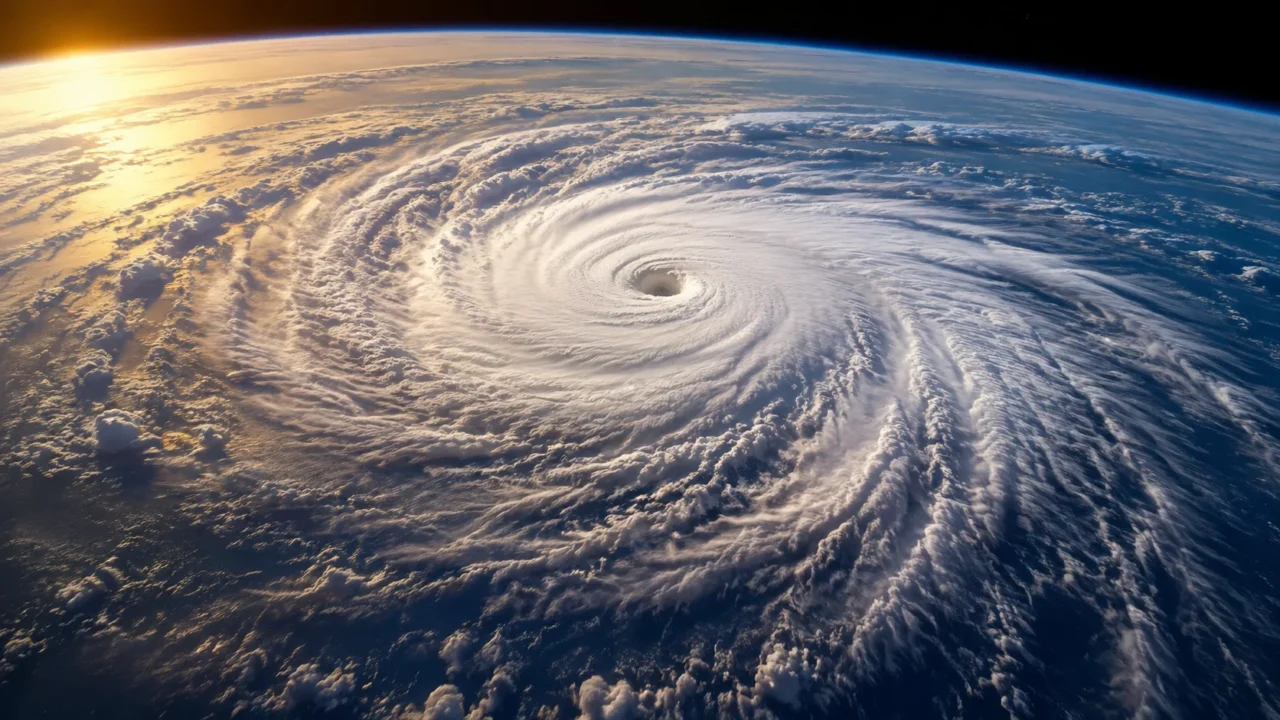
Google DeepMind has introduced an AI weather model that it says gives forecasters more than an additional day of useful lead time when predicting tropical cyclones. WeatherNext Cyclones is designed to forecast three connected features of a storm—its track, intensity and wind structure—within one system.
The results, announced on August 6, 2026 alongside a paper in Nature, indicate that the model’s three-day forecasts are, on average, as accurate as the two-day forecasts produced by earlier models. Google DeepMind describes that gain as roughly equivalent to a decade of meteorological progress, based on accuracy trends observed over the previous 20 years.
The potential value is significant because tropical cyclones, also called hurricanes or typhoons, have caused more than 700,000 deaths and $1.4 trillion in global economic losses over the past 50 years, according to the source. Extra forecasting time could help human forecasters assess risks and issue warnings earlier, although WeatherNext is not a replacement for official forecasts or warnings.
How WeatherNext predicts weather and cyclones
Cyclone prediction traditionally presents a difficult modeling trade-off. A storm’s path is shaped by large global atmospheric currents, which are suited to broad, relatively coarse global models. Its intensity, however, depends on localized thermodynamic processes near the cyclone’s core, an area generally handled by specialized models operating at higher resolution.
WeatherNext Cyclones attempts to bridge those two scales. Google DeepMind describes it as a single AI model capable of predicting global weather while also resolving a cyclone’s track, strength and wind structure. Its performance is attributed to the combination of its training data, architecture and treatment of comparatively low-resolution inputs.
Training across global weather and historical storms
The model was trained end-to-end on two kinds of information: global weather dynamics and expert-curated observations of past cyclones. Its training material included nearly 20 terabytes of global atmospheric data as well as the IBTrACS historical database, which spans nearly 5,000 storms.
Google DeepMind evaluated WeatherNext Cyclones on historical cyclones from 2023 and 2024. The assessment compared both deterministic and probabilistic performance against other leading weather models. Across cyclone track, intensity and wind structure, the reported average gain exceeded a full day, or 24 hours, of lead time.
The source also presents comparisons of three-day forecast accuracy. These contrast WeatherNext Cyclones with ECMWF-ENS track forecasts and HWRF intensity forecasts over time. In the accompanying figures, WeatherNext’s three-day position error is shown at around 100 kilometres, while its intensity error is around 11 knots. The broader claim of a decade-equivalent advance is based on how those results compare with progress over the preceding 20 years.
Ensembles represent uncertainty rather than one fixed outcome
Weather is inherently uncertain, so the system does not rely solely on one predicted future. WeatherNext uses Functional Generative Networks to produce ensembles containing many possible forecasts. These scenarios allow forecasters to inspect a probability distribution and consider unlikely but potentially severe outcomes.
The system can generate a single forecast extending 15 days in less than one minute on a TPU. During the previous year, it generated 50 predictions at a time, matching the ensemble size of global physics models cited by Google DeepMind. That number has now been expanded to 1,000 members for each cyclone.
A 1,000-member ensemble can be used to create localized probability maps covering winds from tropical-storm strength through hurricane force. Google DeepMind says the larger collection is intended to improve representation of rare but consequential scenarios, including rapid intensification. Starting from global atmospheric conditions, the model iteratively predicts both broad weather patterns and fine-scale cyclone tracks as far as 15 days ahead.
Accurate forecasts from unexpectedly coarse inputs
One of the most unusual findings concerns spatial resolution. High resolution has generally been considered central to accurate intensity forecasting, yet WeatherNext Cyclones uses data at a resolution of 28 by 28 kilometres. Google DeepMind says that is 100 times coarser than the inputs used by traditional models.
An even smaller model, WeatherNext 2-mini, operates at 111 by 111 kilometres and is also reported to perform well. The researchers do not yet fully understand how the models achieve this accuracy at such coarse resolution. The source explicitly identifies that question as an open area for research rather than offering a settled explanation.
Experience during Hurricane Melissa
Google DeepMind says the research had an operational impact during the 2025 hurricane season. WeatherNext helped the US National Hurricane Center anticipate Hurricane Melissa’s rapid intensification and landfall in Jamaica. According to the source, this contributed to a historic forecast and enabled the center to issue an advance warning, giving teams on the ground more time to prepare.
The Melissa case also illustrates the intended relationship between AI predictions and expert judgment. WeatherNext produces forecasts and possible scenarios, while trained forecasters interpret that information and make decisions. Google DeepMind developed the work with Google Research and expert forecasters from the National Hurricane Center, the Cooperative Institute for Research in the Atmosphere, the UK Met Office and weather agencies around the world.
Opening up WeatherNext to the research community
Alongside the Nature paper, Google DeepMind is releasing the code and model weights as open source. The release is intended to support academic research, operational forecasting and the development of specialized or localized systems.
The available family includes several related releases:
- WeatherNext Cyclones, the model used during the hurricane season and evaluated in the paper.
- WeatherNext 2, a later update that Google DeepMind says it operationalized in October.
- WeatherNext 2-mini, a compact model that can run on a single TPU through a free public Colab notebook.
The company has also refreshed Weather Lab, its forecast-visualization interface. It now combines cyclone tracks with global forecasts and allows users to view WeatherNext predictions for temperature, precipitation, wind speed and other variables in one place. Both Weather Lab and the WeatherNext models are presented as parts of Google Earth AI.
Pushing the frontiers of AI for weather forecasting
The central result is not merely that WeatherNext can forecast farther into the future. It is that the model reportedly retains at three days the accuracy that previous systems achieved at two days. That distinction matters because a longer forecast is useful only if its errors remain sufficiently controlled. The reported improvement applies, on average, across track, intensity and wind structure.
Google DeepMind positions open access as a way for meteorological agencies, researchers and nonprofit organizations to test the technology, build localized tools and extend its use to other weather problems. Suggested applications include disaster preparation, renewable-energy planning and anticipating extreme weather. Those are intended possibilities, not additional performance results established in the supplied evaluation.
Important limitations and operational caveats
The findings should be interpreted within the scope of the evidence. The historical evaluation covered cyclones from 2023 to 2024, and the detailed claims come from Google DeepMind’s own account of the accompanying research. The source reports average gains, so the more-than-24-hour advantage should not be read as a guarantee for every storm, location or forecast cycle.
The model’s ability to perform well with 28-by-28-kilometre inputs—and the performance of WeatherNext 2-mini at 111-by-111-kilometre resolution—also remains incompletely explained. Open sourcing the models should enable broader investigation, but availability alone does not establish how they will perform in every regional or operational setting.
Most importantly, WeatherNext outputs are not official public warnings. Google DeepMind directs people to their local meteorological agency or national weather service for authoritative forecasts and safety information. The model is presented as a tool to support, rather than displace, the expertise and responsibility of human forecasters.
Acknowledgements
The research was co-developed by teams at Google DeepMind and Google Research. Partner organizations named in the source include the NOAA/NWS/NCEP National Hurricane Center, the Cooperative Institute for Research in the Atmosphere and the UK Met Office. The source also credits the paper’s co-authors: Ferran Alet, Tom Andersson, Ilan Price, Stratis Markou, Andrew El-Kadi, Dominic Masters, Amy Li, Samier Merchant, Natalie Williams, Gregory Thornton, Ken MacKay, Olivia Graham, Akib Uddin, Ben Gaiarin, Devaja Shah, Elinor Kruse, Wallace Hogsett, David Zelinsky, John Cangialosi, Jonathan Martinez, James Franklin, Mark DeMaria, Kate Musgrave, Caroline L. Bain, Helen Titley, Jacklynn Stott, Remi Lam, Aaron Bell, Paul Komarek, Matthew Willson, Alvaro Sanchez-Gonzalez and Peter Battaglia.
Related posts
The original publication points readers to related material about WeatherNext 2 and a May 2026 account of WeatherNext’s role in forecasting Hurricane Melissa’s landfall in Jamaica. It also lists Google DeepMind’s December 2024 post about GenCast and its December 2023 post introducing GraphCast as further reading on the organization’s AI weather-forecasting work.
Source attribution: This article is based solely on the Google DeepMind Blog report, “WeatherNext: AI model achieves breakthrough in forecasting cyclones”, published August 6, 2026.